 The Tactics Academy
The workbook that turns “how do I want my team to play?” into a one‑page answer.
An hour of guided questions with a pen and a clear picture of the players you actually have, rather than a course or another library of theory.
Version two £27, paid once Print-ready PDF, instant download
What coaches said
-
This workbook is an eye opener.
Olaf Wagt Coach
-
It’s so insightful actually putting it on paper.
Richard Harrison U18 Coach
-
This is a must for coaches whatever standard they coach.
Coach
-
I wasn’t expecting it to challenge so deep, which made me feel I have to up my game here and makes me excited to see what I can go out and deliver. It really defines levels: you only get out of something what you put in.
Lee Elwood Coach
-
You will be challenged to reflect on your approach to the game, while envisioning the game from different perspectives. As a coach, we should always seek to gain more knowledge of the game to master our craft.
Coach
-
Even now at 78 and since a very early age I have had Autism. The Game Model Builder has been the best help to me more than virtually anything else, and I don’t say that lightly Lucas.
Gerald Churchyard Coach
Over 500 coaches have bought the Game Model Builder.
Chapter one
Every coach says the same thing.
Ask any coach how they want their team to play and you get some version of this.
We want to play forward, use the width, keep possession of the ball and attack quickly.
-
Play forward to who, in what zone, off what trigger?
-
Use the width with what kind of run, and who is underlapping?
-
Keep possession to draw them out, to rest the ball, or to find a third-man pass?
-
Attack quickly after winning it back where, with how many players, against what kind of block?
The answers live in the detail and detail is what most coaches skip.
Chapter two
The gap is not what you know.
You are not short of knowledge. You watch the games, you have done the badges and you can explain what you are seeing. What you have never been given is somewhere to put it. More content just gives you more to hold. What you actually need is an order to think in.
Chapter three
It does not start at the formation.
- PurposeWin the game
- OutcomesScore goals, stop goals
- PrinciplesHow your team pursues those outcomes
- TacticsHow these players deliver them
- ExecutionWhat they see, what they choose, what they do
The two shaded rows are the ones only you can fill in.
Chapter four
Twelve parts, in the order you have to think in.
Open a part to read what it does.
-
Most coaches cannot actually say how their team plays. This is where we find out why.
-
Five steps, each one answering the question the step above it raised. This will help build clarity.
Purpose, outcomes, principles, tactics, execution. Every tactical conversation ever had is about scoring or stopping goals, however elaborately it is dressed up. This is the part that shows you where any problem sits on that ladder.
-
The word is used constantly in coaching and defined almost never.
-
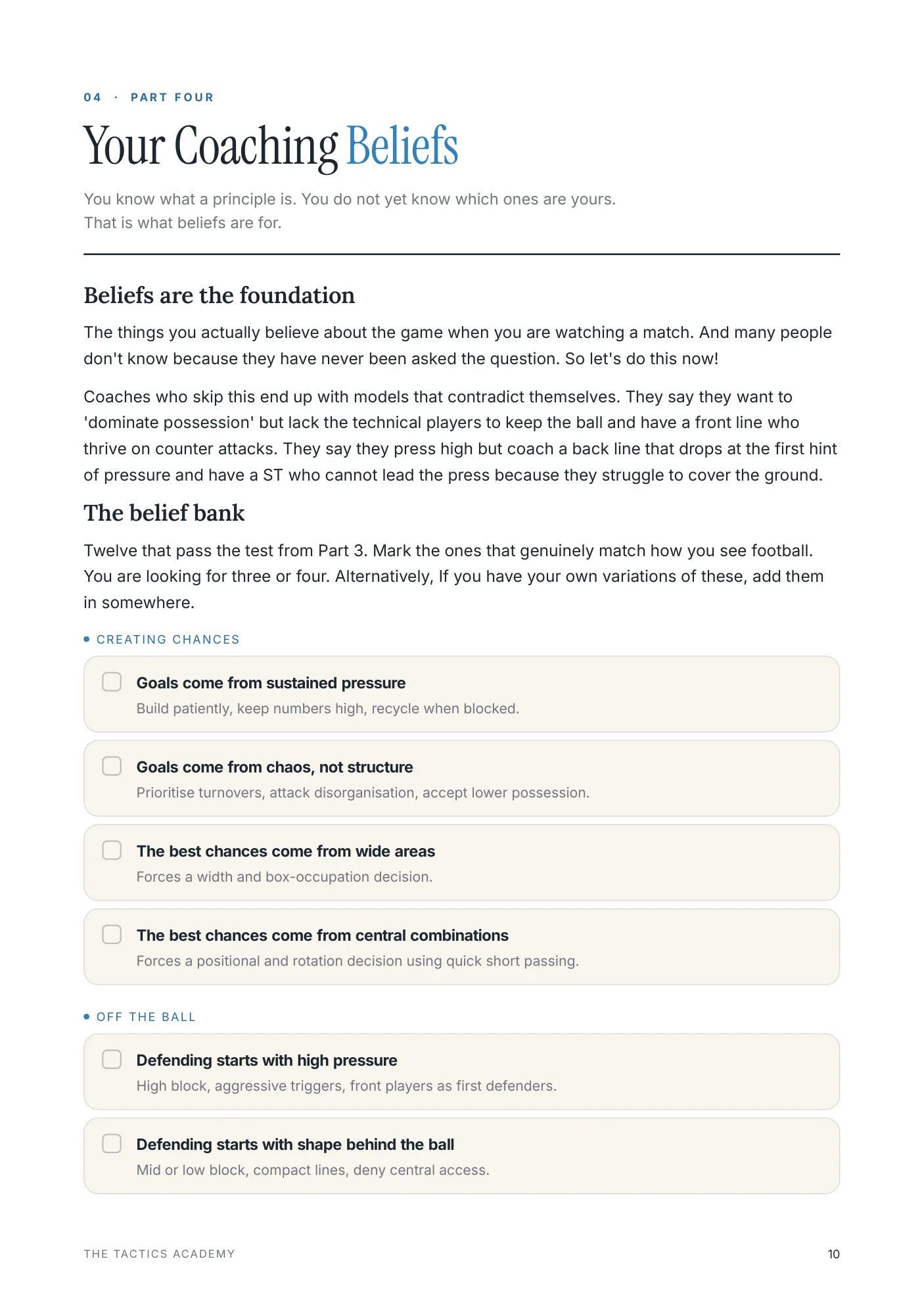
You know what a principle is. You do not yet know which ones are yours. That is what beliefs are for.
-
Formations matter less than coaches think.
-
You have the ball.
-
You do not have the ball.
-
A few seconds each, dozens of times a match.
-
The phase most grassroots models leave out entirely. They decide an enormous amount of matches.
Set pieces sit outside the four moments because they start from a stopped ball, which makes them the one part of the game where preparation converts most directly into outcomes. They are also the best return on limited training time, because a routine drilled for fifteen minutes a week could work against every opponent you face.
-
Matches are rarely normal for ninety minutes. The best models bend, with a stable core and pre-decided adjustments.
-
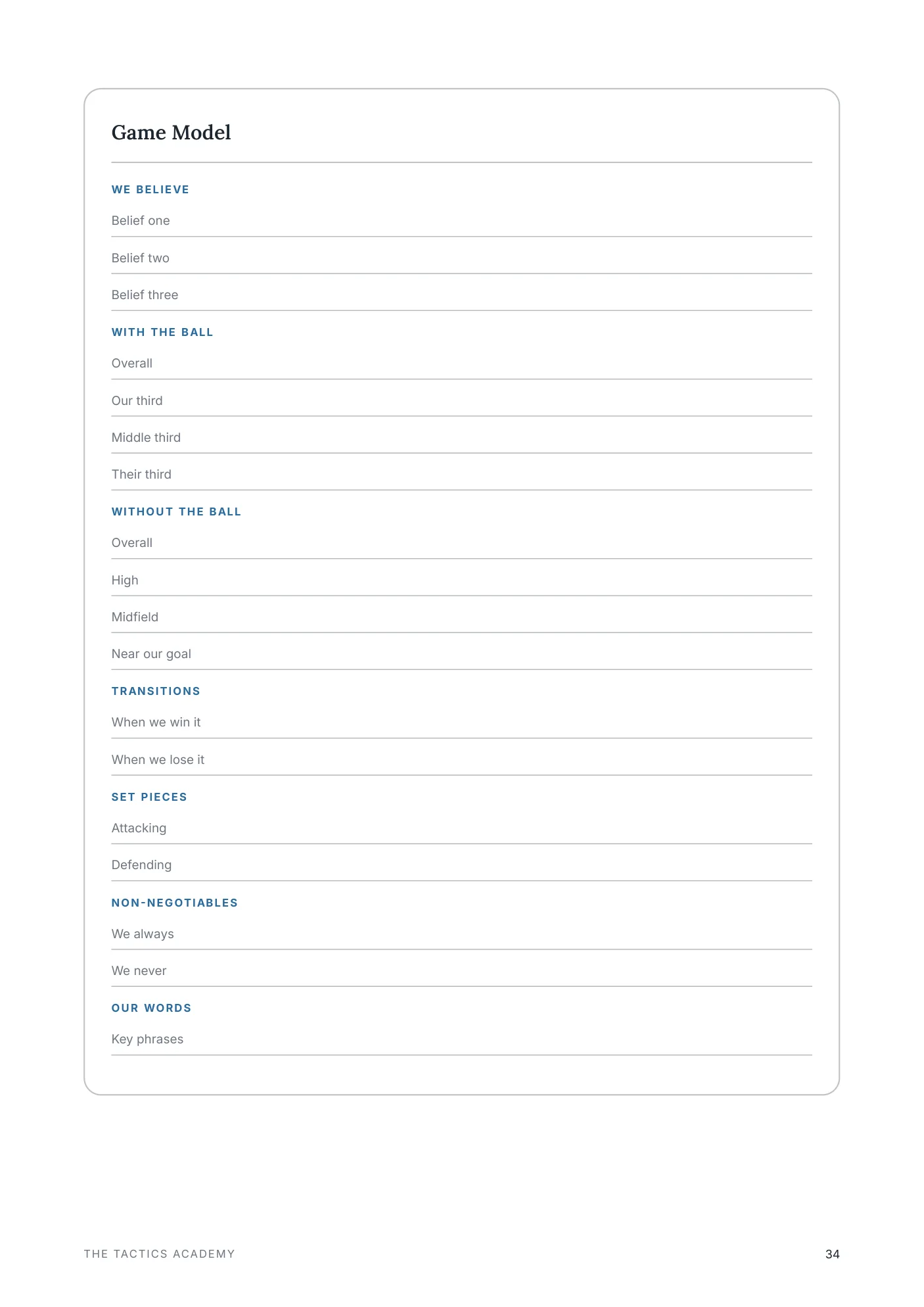
Everything you have built, on a single page your players can actually use. The detailed version is for you. This is for everyone else.
-
A Game Model on paper changes nothing. It becomes real only when it is coached, repeated and lived across months.
Chapter five
Who it is for and who it is not for.
It is for you if
- You coach grassroots or amateur football and you can already see that better coaches see more in a game than you currently do.
- It suits 11v11 most, or any coach whose team is ready to play to a game model.
- You want to learn to think about the game in your own way rather than borrow a finished identity from someone whose players are nothing like yours.
- You are tired of answering “how do we want to play?” with something you can hear is too vague to coach on a Tuesday night.
It is not for you if
- You are looking for a drill library. There are no sessions in here.
- You want a finished tactical identity handed over, because the whole point is that the answers have to be yours.
- You are not willing to sit down for an hour and think honestly about the players you actually have. This is a workbook and it asks you to write in it.
Chapter six
Who wrote it.
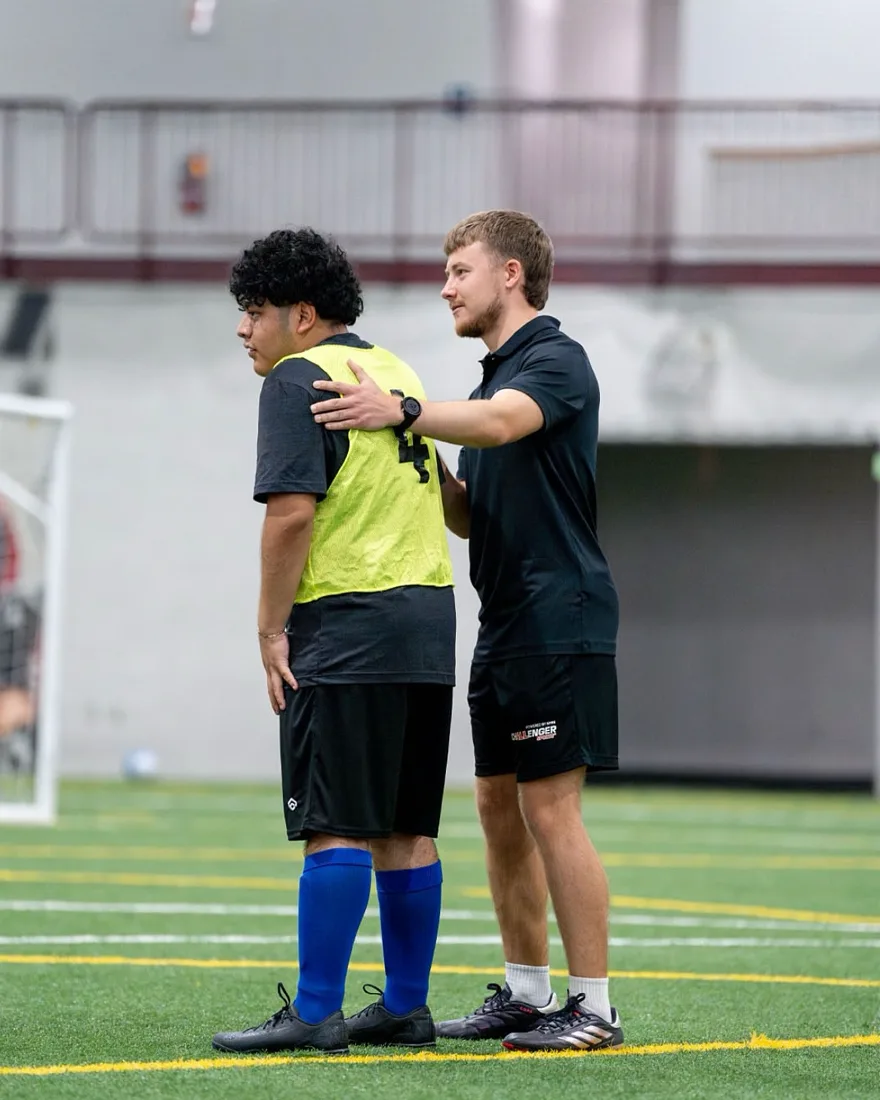
Lucas Sutherland holds a UEFA B Licence and an MSc in Performance Analysis in Football.
He coaches a men’s senior side and high-level academy players alongside running The Tactics Academy full time. This workbook is built from the same thinking he uses on the touchline each week and from years of deep analysis and reflection on the game.
Chapter seven
What you get and what it costs.
You get the Build Your Game Model workbook, version two, and that is what is included. It arrives as a print-ready PDF the moment you buy, it is yours to keep and you can print it as many times as you need.
- Twelve parts, worked in order, from why models fail through to coaching it across a season.
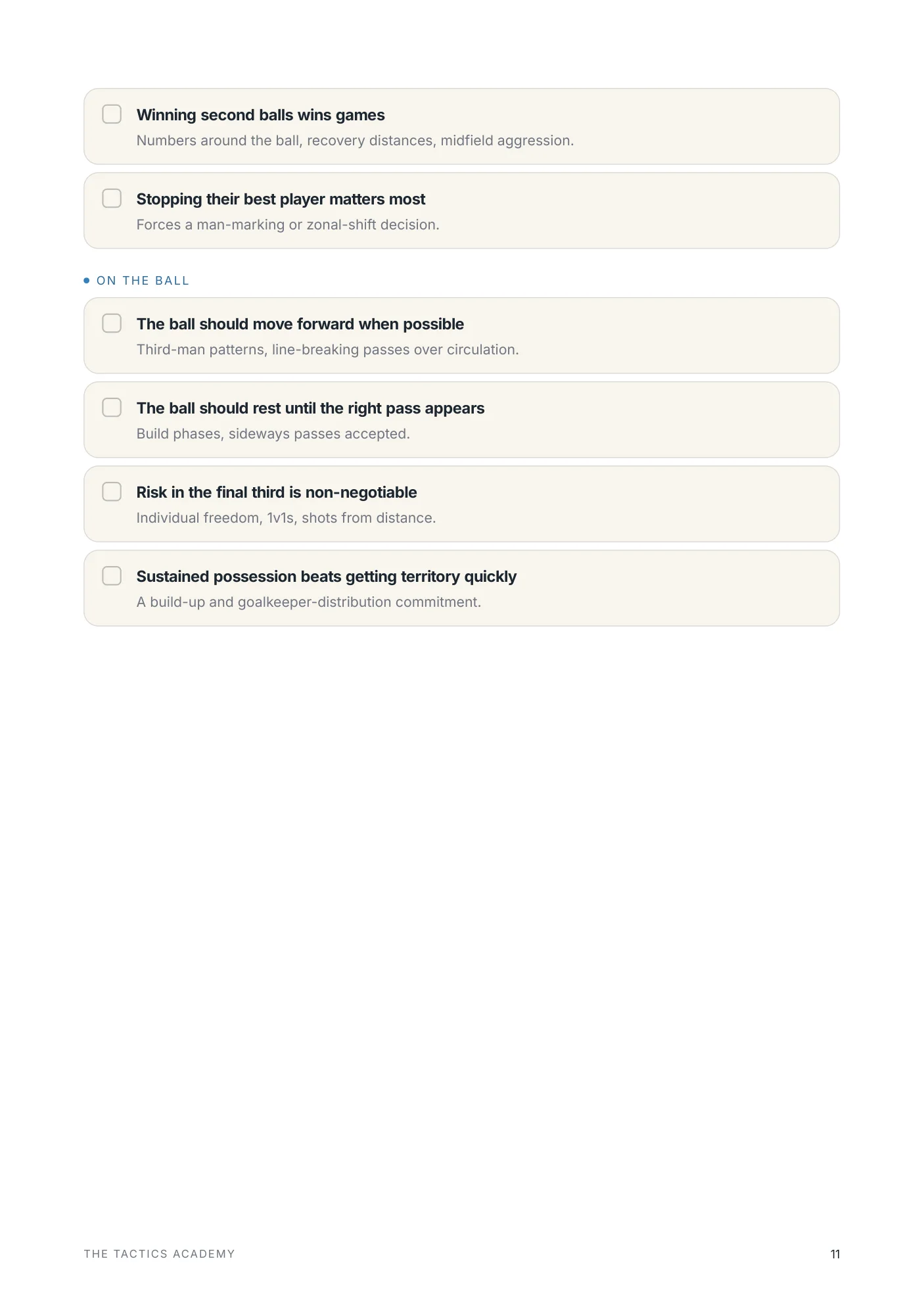
- The belief bank, the structure pages, all four moments and set pieces.
- The one-page Game Model template your players read plus the adaptables sheet you keep.
£27
One time. Not a subscription.
Instant access through Beehiiv.
The Tactics Academy
An hour, a pen, and you can finally say it out loud.
£27, paid once. Print-ready PDF, delivered instantly.
Every box in the workbook relies on you already understanding the concept underneath it. The theory layer that fills those boxes is what the 7-Day Tactical Coach System teaches. 300 coaches have worked through it.
© The Tactics Academy Ltd